The Flashing Light Is Not a Measure of Certainty
A flashing casino light can make an outcome feel predictable. Learn how displays shape attention, what they actually signal, and how to read them clearly.
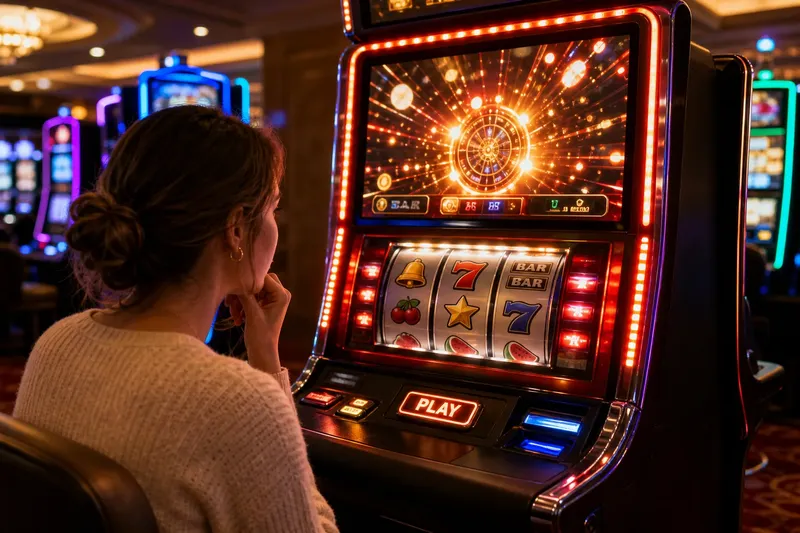
Why can a flashing light make a casino result feel more predictable when it does not change the game? The display grabs attention, marks an event, and invites interpretation; the game outcome comes from a separate process. Keeping those jobs distinct helps you read a machine without treating its animation as evidence of what will happen next.
What does a flashing light actually tell you?
A light tells you that the machine is presenting a signal. Depending on the design, it may mark a button becoming available, announce that a round has ended, draw attention to a win, or add emphasis to a transition. Its meaning comes from the machine’s rules and interface, not from brightness or motion alone.
Think of a doorbell: a chime tells you someone pressed it, not who is outside. In the same way, a cabinet’s pulsing rim might indicate an event that has already occurred, while a small indicator near a control might show that an option is available. You need the surrounding labels, timing, and game context to tell which.
Separate three questions when looking at a display: What happened? What is the machine inviting me to do? What, if anything, does this signal say about a future result? The first two may have clear answers. The third often does not follow from the light itself.
Why does vivid motion feel like a forecast?
Moving light is hard to ignore. A sweeping band, a burst of color, or a fast sequence of flashes makes an event feel important and immediate. The mind may then attach that sense of importance to the result, even though the display’s energy is a property of the presentation.
Timing adds to the impression. If lights intensify just before an animation stops, the buildup can feel like a signal that something favorable is approaching. But a dramatic pause is still part of the interface. Unless the game’s stated rules explain a connection, the pause and the outcome should be treated as separate things.
Color can also carry learned associations. Gold may suggest a reward; red can suggest urgency; green may suggest permission or progress. These conventions make a display easier to interpret emotionally, but they do not reveal how a game determines its result.
Does a brighter display mean a better chance?
No. Brightness is a design choice, not a measure of probability. A cabinet may use a bright animation to celebrate a completed event, to maintain attention, or to distinguish an active control from the background. None of those visual properties, by themselves, establish that a future result is more likely.
It helps to distinguish a signal from a forecast. A signal can indicate a current state, such as a round ending or a button being ready. A forecast makes a claim about what has not happened yet. A light can function as the first without serving as the second.
Imagine you see a fictional game cabinet flash around its screen after a round, then show a button labeled “Play.” The flash marks the completed round and the button invites another action. It does not, on its own, suggest that the next round will produce a particular result.
How can you separate presentation from outcome?
Start with the plainest available information: the screen’s words, the control labels, and the rules displayed for the game. Then ask what the animation accompanies. If it follows a completed round, it may be an acknowledgment. If it highlights a control, it may be directing attention. Do not infer a future result merely because the display is elaborate.
- Read the message. Check whether the screen names a result, describes a feature, or simply shows an animation.
- Locate the signal. Notice whether the light is attached to a control, a result panel, or the cabinet as a whole.
- Check the timing. Ask whether the display appears before an action, during a transition, or after a result.
- Look for a stated rule. Treat an effect as informative about outcomes only if the game’s instructions explicitly explain that link.
- Pause before acting. If the animation creates urgency, wait until it ends and read the available options without its visual pressure.
This is a way to read an interface, not a way to predict a game. When rules or signals are unclear, avoid treating decorative motion as an answer.
Can a light ever be meaningful information?
Yes, but its meaning needs to be specific. An indicator can communicate that a control is active, that a round has ended, or that a feature has been triggered. Those are statements about a machine’s current state or an event it has already recorded, not necessarily clues to a later outcome.
Some games also describe features that affect how play proceeds. If a display is tied to such a feature, consult the written rules rather than reading meaning into the animation alone. The instructions should explain what the feature does and when it applies; if they do not, the light is not a reliable substitute for that explanation.
There is a useful engineering distinction here. A sensor indicator, for example, can report that a sensor has changed state, but it does not explain every cause of that change. Likewise, a game display may faithfully announce a state without forecasting what comes next.
What should you look for when reading a game display?
Ask what job each visual element performs. A number may show a current balance or score; a label may name a control; a moving graphic may simply animate the transition between screens. Identify the element’s stated role before treating it as a clue.
Also notice where information is placed. Important instructions may appear in a rules panel or on a screen reached through a help button, while decorative effects occupy much more of the cabinet’s surface. Larger and brighter does not necessarily mean more informative.
If you are comparing two machines, compare their written game rules and interface labels, not how forcefully they animate. Two displays can use very different visual styles while communicating the same kind of event. The style tells you about presentation; the rules tell you what the game says its features mean.
Can flashing lights make a player feel rushed?
They can create a sense of urgency, especially when paired with a countdown, a pulsing control, or a rapid sound cue. That feeling is an interface effect. It does not mean you must act immediately unless the rules clearly state that an option or turn is about to expire.
Give yourself a moment to read the screen and decide whether to continue. If the machine offers a help or rules control, use it when you need clarification. If the lights or sounds make it difficult to think comfortably, stepping away is a reasonable choice.
For families or groups discussing casino design, it can help to ask what a display is asking the viewer to notice. That question shifts attention from “What will happen?” to “What does the machine want me to see or do right now?”
Does a previous flash predict the next result?
A previous animation is not a dependable basis for predicting a later game result. It may show what the machine just displayed, or signal a current interface state, but the visual sequence alone does not establish what will happen in another round.
It is tempting to look for a pattern in repeated flashes, colors, or pauses. Before assigning meaning, check whether the game’s rules define that pattern as part of an outcome feature. If they do not, treat the pattern as presentation rather than a forecast.
The practical distinction is simple: read the light as information about the moment it marks, not as a promise about what comes next. A vivid display can be memorable without being predictive.
What should you remember when a cabinet lights up?
When a cabinet flashes, identify the message, the moment it refers to, and the action it invites. Then keep those observations separate from any guess about a future result. The display may be communicating something real about the interface while saying nothing about what the next play will produce.
The flashing light is not a measure of certainty: it is a designed signal whose meaning depends on the rules and context. If you want to understand a game, give more weight to its stated instructions than to the drama of its animation—and make your choice only after the display has stopped demanding your attention.