Inside the Card Shoe: A Sequence of Small Movements
Inside the card shoe, guided surfaces turn a stacked deck into a repeatable draw; follow the parts and motions that keep cards moving in order.
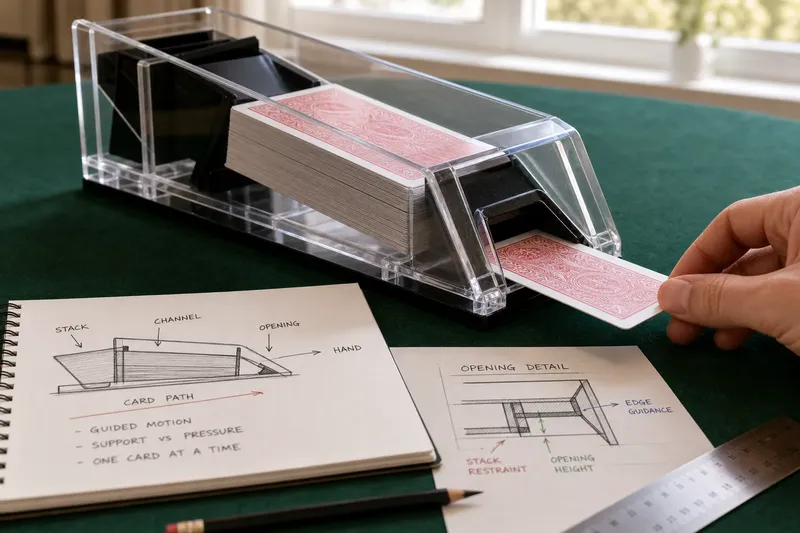
How does a card shoe turn a squared stack into one card at a time? Inside the card shoe, the answer is a chain of small, guided movements: a stack rests against a support, a face card meets an opening, and a hand draws it along a constrained path. You can study that sequence without considering any game result.
Use a week to examine the mechanism at a calm pace. A paper sketch, a ruler, and a clean, unused shoe are enough for observation; do not force parts or dismantle a device. If the shoe is casino equipment, follow its label and the manufacturer’s instructions.
Start by tracing the card path
On the first day, set the shoe on a stable table and look at it from above, the side, and the front. Identify the broad channel that holds the stack, the front opening where cards emerge, and any visible guide or retaining feature near that opening. Names and shapes vary, so describe what you see rather than assuming every shoe uses the same design.
Draw the card’s route as a simple line: stack, front card, opening, hand. Add arrows for the direction of travel. The point is to separate the card’s path from the person’s action. A hand supplies the pull, but the shoe’s surfaces limit sideways drift and help keep the next card behind the one being drawn.
Write down what is fixed and what moves. The housing is stationary during ordinary use; cards shift within it, and a movable retainer may be present on some designs. This inventory prevents a common mistake in mechanism sketches: treating the whole object as if it moves together.
See how the stack stays presented
On the second day, focus on how the stack meets the front of the shoe. Cards are thin and flexible, so a loose stack can bow, fan, or slide out of alignment. The channel’s side walls and floor give the cards boundaries. The stack’s own weight, its orientation, and any fitted retaining part help keep the front card available at the opening.
Notice the difference between support and pressure. A wall supports an edge by limiting its travel; a retainer may apply pressure or block an unintended path. Neither needs to push the card forward. Instead, the design keeps the stack positioned so a deliberate draw can move the exposed card.
Imagine placing a slightly uneven stack in a shoe with a wide channel. If the sides do little to constrain it, the front edges may sit at different positions, making the draw less orderly. A better-aligned stack meets the opening more consistently, so the visible card has a clearer route. This is an illustration of guided motion, not a claim about every shoe.
Follow the separation at the opening
On the third day, study the point where one card leaves the stack. The front edge of the shoe acts as a boundary: it allows a card to pass through a selected opening while the rest remain supported behind it. The fit has to leave room for a card to move without leaving an unrestricted exit for the stack.
Watch for three interacting details:
- Opening height: the gap must accommodate the intended card path.
- Edge guidance: nearby surfaces help keep the drawn card aligned as it passes the front.
- Stack restraint: the remaining cards need support so a pull on the front card does not simply shift the whole stack.
These features work as a system. A narrow opening alone does not explain controlled movement; the position of the stack and the direction of the pull matter too. If you sketch the opening, mark where a card is supported before, during, and after it crosses the front edge.
Compare a draw with a reset
On the fourth day, distinguish the drawing motion from preparation for another draw. During a draw, the leading card travels outward while the remaining stack stays in the channel. Between draws, the shoe may need a small adjustment to keep the newly exposed front card presented. Depending on the design, that adjustment can involve the stack settling or a movable feature being repositioned.
Keep the comparison observational. Do not try to make a shoe behave in a way its instructions do not describe. Instead, note the sequence shown by its parts: what changes after a card leaves, what remains stationary, and what restores the starting arrangement for the next card.
Say you are documenting an empty demonstration shoe with a practice stack. You draw the top card along the opening, then pause to see whether the remaining stack settles against the front guide. The expected observable result is a newly presented leading card, not a change in the order of the cards. The example describes a possible observation, not a test or a promise that every design responds identically.
Check how friction shapes the motion
On the fifth day, consider contact between surfaces. A card rubs against neighboring cards and may brush the channel or front guide as it moves. Too little constraint can let the stack wander; too much resistance can make a card hesitate or require an awkward pull. The design balances free travel with enough guidance to preserve alignment.
Surface condition matters, but avoid diagnosing a problem from one sensation alone. Dust, worn edges, a bent card, or a stack that is not squared can all affect the motion. For a teaching demonstration, use clean cards in ordinary condition and keep the shoe’s surfaces unobstructed. Do not add oils, sprays, or improvised liners; such changes can alter friction and may damage the object.
Make a short note about where contact appears likely: along the channel floor, at a side wall, or near the exit. A simple contact map makes the mechanism easier to explain than a vague statement that cards “slide through.”
Answer the questions that clarify the mechanism?
Does the shoe choose which card comes out?
No. The shoe organizes and guides the stack’s movement; it does not determine a game outcome. The card order is already present in the stack.
Why does the stack need side walls?
Side walls limit sideways movement and help keep card edges aligned with the opening. Their role is guidance, not selection.
What makes one card separate from the next?
The opening and the direction of the pull let the leading card travel outward while the rest remain supported. Exact details depend on the shoe’s construction and condition.
Can every card shoe be understood from the outside?
You can observe the channel, opening, and visible moving parts without disassembly. Internal features may differ, so describe only what is visible unless you have an authorized parts diagram.
Finish the week with a motion diagram
On the final day, turn your notes into a compact sequence. Use one box for the resting stack, one for the exposed front card, one for the card crossing the opening, and one for the newly presented stack. Add arrows for the draw and any visible resetting movement. Label which parts guide, support, or move.
Then read the diagram as a mechanical explanation: the channel contains the stack, the front boundary exposes a path, a hand supplies motion, and the remaining cards stay supported for the next draw. This account keeps attention on the shoe rather than on what a player does with a card.
A useful way to describe the inside of the card shoe is to name each contact and each change of position. That habit makes a small mechanism legible: not a mysterious box, but a sequence of constrained motions that can be observed one card at a time.