From Hand-Cranked Wheel to Electric Display
From hand-cranked wheel to electric display: follow how casino apparatus changed its motion, what powered mechanisms made visible, and what designers traded away.
How did a casino wheel move from a visible turn of the hand to an electric display that seemed to animate itself? The shift from hand-cranked wheel to electric display was not simply a change in power source. It altered what visitors could see, hear, and infer about the machine. A single invented exhibit can make that transition easier to follow.
Imagine a small exhibit built around a wheel
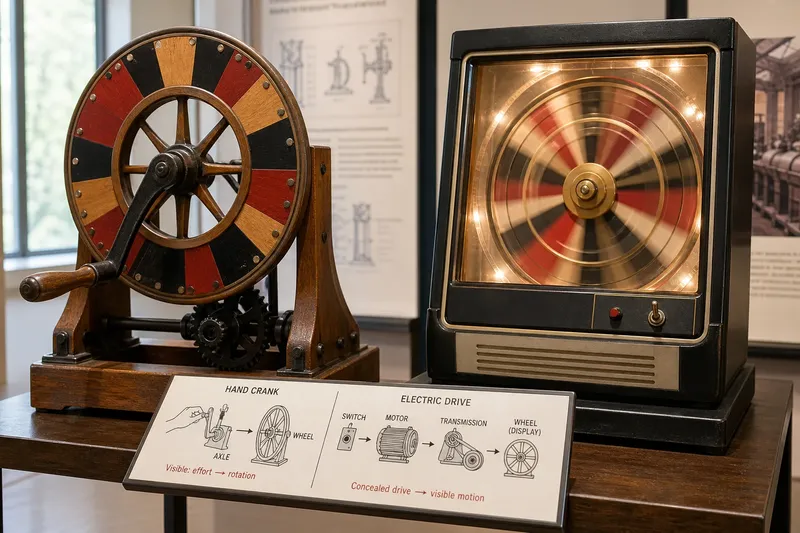
Imagine a curator assembling a hypothetical teaching exhibit about casino apparatus. At one end sits a wooden wheel with a hand crank; at the other, a later electric display with a rotating visual element behind a panel. The curator wants visitors to understand not just that electricity replaced manual effort, but how each design presented motion.
For the first display, she chooses a simple wheel, a central axle, a crank, and a frame that holds the wheel upright. Turning the handle transfers motion directly through the axle. The visitor can watch the hand move, see the wheel respond, and hear the mechanism as it turns. Effort, cause, and visible movement occupy the same moment and place.
The curator then places an electric display beside it. Here, an electric motor supplies the turning force, while a switch controls when the motion begins. The source of the movement is no longer the visitor’s hand. A cover can conceal the motor and transmission, leaving the moving image as the main thing on view.
Her exhibit is invented, but the comparison draws on a broad engineering history: as power sources changed, designers could separate the person who initiated motion from the mechanism that produced it.
Manual motion made the mechanism part of the event
A hand crank turns muscle movement into rotation. The user applies force at the handle; the crank carries that force to an axle; and the wheel follows. That chain is easy to grasp because the action and its effect are connected in plain view.
Manual operation also gives the object a human rhythm. A person may turn steadily, pause, or start again. The mechanism’s response remains tied to that effort, making the device feel handled rather than self-acting. The crank, axle, wheel, and supporting frame are not background hardware: together, they explain the movement.
For a casino apparatus, this visible connection could contribute to a sense of ceremony. The operator’s action began a sequence, and observers could follow the apparatus as it moved. That did not make the mechanism’s outcome predictable; it made the source of motion easier to see.
When describing a hand-powered object, start with the route from hand to moving part.
Electric power separated the trigger from the movement
An electric motor changes the arrangement. Instead of a person continuously supplying the turning force, a motor converts electrical energy into rotation. A switch, button, or other control can initiate the operation, while the motor continues to drive moving components.
This separation gives designers more options for presenting motion. They can hide the motor, place controls away from the moving part, or use a transmission to carry rotation to another location. Gears, belts, shafts, and linkages can each alter how force reaches the visible element, though the specific arrangement depends on the apparatus.
The display may look as if it moves on its own because the source of its motion sits out of sight. That impression is a design effect, not a disappearance of mechanical cause. Behind a changing image, some combination of electrical input, motor action, and moving parts still connects the control to the display.
The changing motion altered what visitors could read
With the crank, motion is exposed as a sequence: a hand moves, the axle turns, and the wheel follows. Electric operation can compress that sequence into a simple cue. A visitor presses a control, then sees the display animate while the power source remains invisible.
That change affects attention. A visible crank invites the eye to track the operator and mechanism; a concealed drive directs attention toward the result. Sound can shift, too. A manual wheel may communicate movement through the contact of parts and the operator’s action, while a powered display can pair motion with a switch click, motor hum, or designed signal.
Neither presentation is inherently more honest or more engaging. Each reveals different parts of the system. A useful exhibit can make the hidden drive legible without pretending that a visitor can infer every internal detail just by looking.
How should you compare the two forms of motion?
What does a hand crank reveal?
A crank makes the input force and the beginning of rotation visible together. It helps a visitor connect human effort with mechanical response, although internal friction, gearing, or other details may still be concealed.
What does an electric motor change?
A motor supplies sustained rotation without a person turning the mechanism continuously. This allows the control, power source, and moving display to occupy separate places, so the visible motion may offer fewer clues about its origin.
Why conceal a motor or transmission?
Designers may conceal working parts to keep attention on the display, protect components, or fit them into a compact enclosure. A clear panel or a separate cutaway can restore some mechanical context without putting the drive itself at the center of the presentation.
Can the display explain its own mechanism?
Not by appearance alone. A short label, diagram, or visible model can identify the path from control to power source to moving element, helping visitors distinguish what they can observe from what the enclosure hides.
The exhibit turns a broad shift into a visitor decision
In the invented exhibit, the curator first places the two machines side by side and notices that visitors look mainly at the electric display’s animated surface. She adds a diagram showing the switch, motor, and route of rotation, then adjusts the exhibit so the hand crank and its axle remain unobstructed. The expected observable result is that visitors can compare both the motion and its source, rather than seeing only two different-looking objects.
That design decision captures a useful lesson from the transition: powered apparatus did not eliminate mechanical motion; it rearranged where the motion began, how it was transmitted, and what the audience could see. In an engineering-history display, a labeled drive path can make this shift clear without claiming that one form replaced every other form everywhere.
When you encounter a casino display, trace the visible motion backward: identify the moving element, look for its control, and ask what source of force the housing may conceal. That simple habit turns an animated surface into a question about design history.