A Museum Visit for Reading Casino Objects
A museum visit for reading casino objects can turn quiet observation into a clear record of materials, visible joints, and intended interaction.
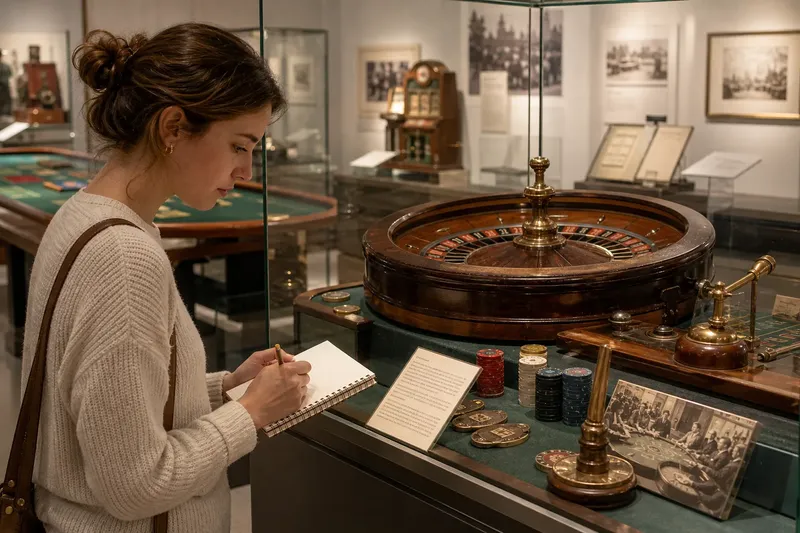
What can you learn from a casino object when the case is closed and touching is off limits? A museum visit for reading casino objects starts with a simple discipline: observe what is visible, separate evidence from inference, and record how the object seems designed to be encountered. That approach works for a roulette wheel, a chip, a gaming table, a sign, or a machine on display.
The difficulty is that familiar objects invite quick assumptions. A polished surface may look like metal but be a coating; a seam may be decorative rather than structural; a lever may suggest an action that visitors are not meant to perform. Use the visit as a quiet investigation, not an attempt to reconstruct operation. Your notes can still reveal how materials, joints, shape, and display choices direct attention and suggest use.
Start by recording what the case lets you see
Before interpreting an object, make a compact record of its setting. Note the label, the object’s position, the direction it faces, and anything that blocks or reveals a view. A glass case, a raised plinth, a spotlight, or a nearby image changes what you can inspect. These conditions belong in your notes because they affect the evidence available.
Write down observable details in plain language: “round wooden body,” “bright metal rim,” “small marks along the edge.” Avoid conclusions such as “built for speed” until you can point to a feature that supports them. If the label identifies a material or purpose, record that as label information rather than your own observation.
A useful page layout has three short columns:
- Seen: visible color, form, surface, marks, and position.
- Possible meaning: cautious interpretations tied to a specific feature.
- Question: what remains unclear from this viewpoint.
This separation prevents a polished guess from quietly turning into a fact. Start with the visible, then add interpretation only when you can name its evidence.
When the material is hard to identify, describe its surface first
One common snag is trying to name a material from appearance alone. Dark brown may be wood, painted metal, molded plastic, or a composite with a surface finish. A silver-colored edge could be metal, plated material, or a reflective coating. Display lighting and protective glass can alter color and gloss.
Instead of writing “brass” or “leather” without support, record what your eyes can establish: smooth or textured, matte or reflective, uniform or mottled, rounded or sharply edged. Note visible wear, if present, without deciding what caused it. A rubbed patch might suggest repeated contact, but it could also reflect cleaning, age, or display conditions.
Then check the museum label and any nearby object notes. If the label names a material, distinguish that information from your own visual assessment. If it does not, keep the entry open: “warm-colored, reflective rim; material not identified.” That is more useful than a confident but unsupported guess.
When appearance is ambiguous, describe the surface rather than forcing a material name.
When a seam looks functional, trace what it actually connects
Visible joints are another source of overconfidence. A line around a panel might mark a lid, a fitted insert, a decorative border, or a boundary between finishes. Screws, pins, rivets, hinges, and brackets can offer stronger clues, but their presence alone does not reveal how an object moved or came apart.
Look for continuity. Does the seam run around an entire panel or stop at a corner? Is a hinge visibly attached to two parts? Do fasteners appear in a repeated pattern? Is there a gap, a shadow line, or only a change in color? Record the relationship between parts before assigning a purpose to the joint.
Do not infer that a visible hinge was meant for visitors to open, or that a slot was designed for a particular token. Museum objects may be incomplete, modified, or displayed with parts hidden. Your task is to identify what the joint suggests and what the display does not establish.
A precise note might read: “Two small metal plates meet along the rear edge; a narrow dark line follows the join.” It avoids claiming that the plates form an operating hinge unless that movement is documented by the label or another museum resource.
When intended interaction is unclear, read the object’s cues
A casino object often signals a way to engage through its shape. A broad, flat surface may invite placement; a handle may suggest grasping; a marked area may direct a choice or point of attention. These are design cues, not proof of actual use. Look at how the object presents itself and how the museum presents it.
Separate three questions in your notes: What action does the form seem to invite? Which feature suggests that action? What information would confirm it? For example, a circular opening might suggest inserting something, but a label, archival image, or related object would be needed to identify what belongs there.
Also note whether the object is shown in a context that clarifies interaction. A chip displayed beside a rack may communicate sorting or storage more readily than a chip shown alone. A table layout may indicate where participants faced, while still leaving rules or specific motions uncertain. Describe the arrangement without pretending that a static display shows a complete sequence.
When the view is blocked, change your position rather than your method
Cases and crowded galleries can hide the detail you want. A rear surface may be invisible from the main viewing point; glare may obscure a label; a neighboring visitor may temporarily block the sightline. The tempting response is to lean on the case, reach around a barrier, or look for a way to move the object. Do not. Keep to the gallery’s visitor boundaries and make the best record available from an approved position.
Try a modest change of viewing angle if the gallery allows it. Step to the side, lower or raise your gaze without leaning on fixtures, and look for a second label or photograph nearby. If the gallery is busy, note the missing detail and return later. A question left open is better than an observation created by an unsafe or prohibited approach.
For a view you cannot obtain, write “rear surface not visible from permitted viewing area.” That note tells a later reader why the record is incomplete.
When notes become vague, tie each claim to a visible feature
Notes like “interesting construction” or “probably used by the dealer” are difficult to revisit because they do not preserve the reasoning behind them. Replace them with a feature and a modest inference: “raised rim surrounds the central field; it may help keep loose pieces within the surface.” The second clause remains tentative, while the first can be checked against the object.
Use sketches sparingly but purposefully. A simple outline can show where a seam, handle, mark, or opening sits. Do not draw details that the case prevents you from seeing. A question mark beside a feature is a useful reminder that the drawing records an impression, not a measured diagram.
Imagine you are looking at a small wooden box with a metal-edged lid, a narrow gap at the front, and no visible label explaining its use. You could note the wood-like grain, reflective edge, and front gap, then sketch their positions. You might ask whether the gap is an opening or a join, but you would not identify the box’s contents or claim how it was operated. The expected result is a record another person can understand without mistaking your question for a fact.
Which details should you check before leaving?
What counts as a material observation?
Record visible qualities such as texture, color, reflectivity, and wear before naming a material. Use the museum label for a stated material, and mark any visual identification as uncertain when the display does not confirm it.
How can I tell a joint from a decorative line?
Look for a gap, fasteners, adjoining edges, or a continuous boundary that links separate parts. If the line has no visible structural clues, describe its location and appearance without calling it a joint.
How do I infer intended interaction without operating the object?
Identify a shape or feature that seems to invite an action, such as a handle, marked surface, or opening. Keep the action as a possibility until a label or contextual display supports it; do not touch, turn, or activate the object.
What should I do if the label and object seem to disagree?
Record the label’s wording separately from what you can see, then note the specific difference. The object may be incomplete, restored, or presented in a way that hides a feature, so avoid resolving the mismatch by guessing.
Close the visit with a clean observation record
Before moving on, take a moment to check that each note has a subject and a location: “scratch near the left edge,” not simply “scratch.” Separate label facts, visual observations, and tentative interpretations. Add the viewing limitation if a surface, joint, or mark could not be seen. If photography is permitted, follow the museum’s rules and use images to supplement—not replace—written descriptions.
For a focused record, make sure you have noted:
- The object’s name as the museum gives it, or a neutral description if no name is supplied.
- The display context and the viewpoint from which you observed it.
- Visible materials or surface qualities, with uncertain identifications marked.
- Joints, seams, fasteners, openings, and how they relate to one another.
- Features that suggest an interaction, along with the evidence for that interpretation.
- Details blocked by the case, lighting, or visitor boundary.
- One unanswered question that could be checked through the museum’s label or collection information.
This kind of record makes a museum visit for reading casino objects more than a glance at familiar forms. It gives you a disciplined way to connect material, visible construction, and suggested interaction while respecting the object and the limits of the display. Keep the distinction between seeing and inferring, and even a short gallery visit can leave you with useful questions about how an object communicates its purpose.
When you return to your notes later, preserve the uncertainty instead of smoothing it away. A clearly marked unknown can guide your next museum question; an unsupported answer can only hide what you did not see.